First Nations
Berg lies within the Wet'suwet'en Yintah, in the territory of the Thin House (Yextsowiten) of the Gilseyhu Clan, and within the asserted traditional territory of the Cheslatta Carrier Nation. This page describes the governing bodies the IPD names, what the record says about each, and who has asked to take part in the assessment.
In brief
Chapter 6 of the IPD covers the Office of the Wet'suwet'en (OW), which represents the Hereditary Chiefs, and five Band-governed Nations: Witset, Wet'suwet'en First Nation, Skin Tyee, Nee Tahi Buhn and Cheslatta Carrier Nation. Most of what the IPD says about their interests is Surge Copper's own summary. In their own words, the record so far holds four notices of intent to participate, filed within a month of the joint EAO and federal letter of September 15, 2026. They come from Witset, Wet'suwet'en First Nation, the House of Anaskaski and Skin Tyee. The Environmental Assessment Office (EAO) decides which Nations become participating Indigenous nations during Early Engagement. Source: IPD, p. 6-1; Anaskaski House notice, Oct 14, 2026, p. 1; IPD, p. 5-7, Table 5.6-1.
The Wet'suwet'en Yintah
The IPD describes Wet'suwet'en hereditary governance from public information and discussions with the OW. It notes that the Wet'suwet'en "will determine how they wish their people, governance systems, and culture to be reflected within the assessment process". Source: IPD, p. 6-7.
- The Wet'suwet'en are governed under "a matrilineal hereditary system of thirteen House Groups, led by Hereditary Chiefs". Source: IPD, p. 6-7.
- According to the Wet'suwet'en, and as reiterated in the Delgamuukw/Gisday'wa decision, they "have never ceded, surrendered or in any way relinquished Title or Rights over any portion of the 22,000km2 Yintah". Source: IPD, p. 6-7.
- The five clans are Gilseyhu (Big Frog), Laksilyu (Small Frog), Gitdumden (Bear/Wolf), Laksamshu (Fireweed) and Tsayu (Beaver). Source: IPD, p. 6-7.
- The Thin House is represented by Pat Morris (Chief Casbit), who with Herb Naziel (Chief Samooh) and Helen Michell (Chief Ludooks) represents the Gilseyhu Clan as a whole. Source: IPD, p. 6-7.
- In 2020 Canada and BC signed a memorandum of understanding with the Hereditary Chiefs recognizing Wet'suwet'en rights and title under their hereditary system. Surge states it is not aware that the further agreements the memorandum contemplates have been concluded. Source: IPD, p. 6-6.
The OW-led Project Assessment is to be "the primary means of substantively engaging" the Hereditary Chiefs and House members; Surge also engages elected Chiefs and Councils separately. Source: IPD, p. 1-4.
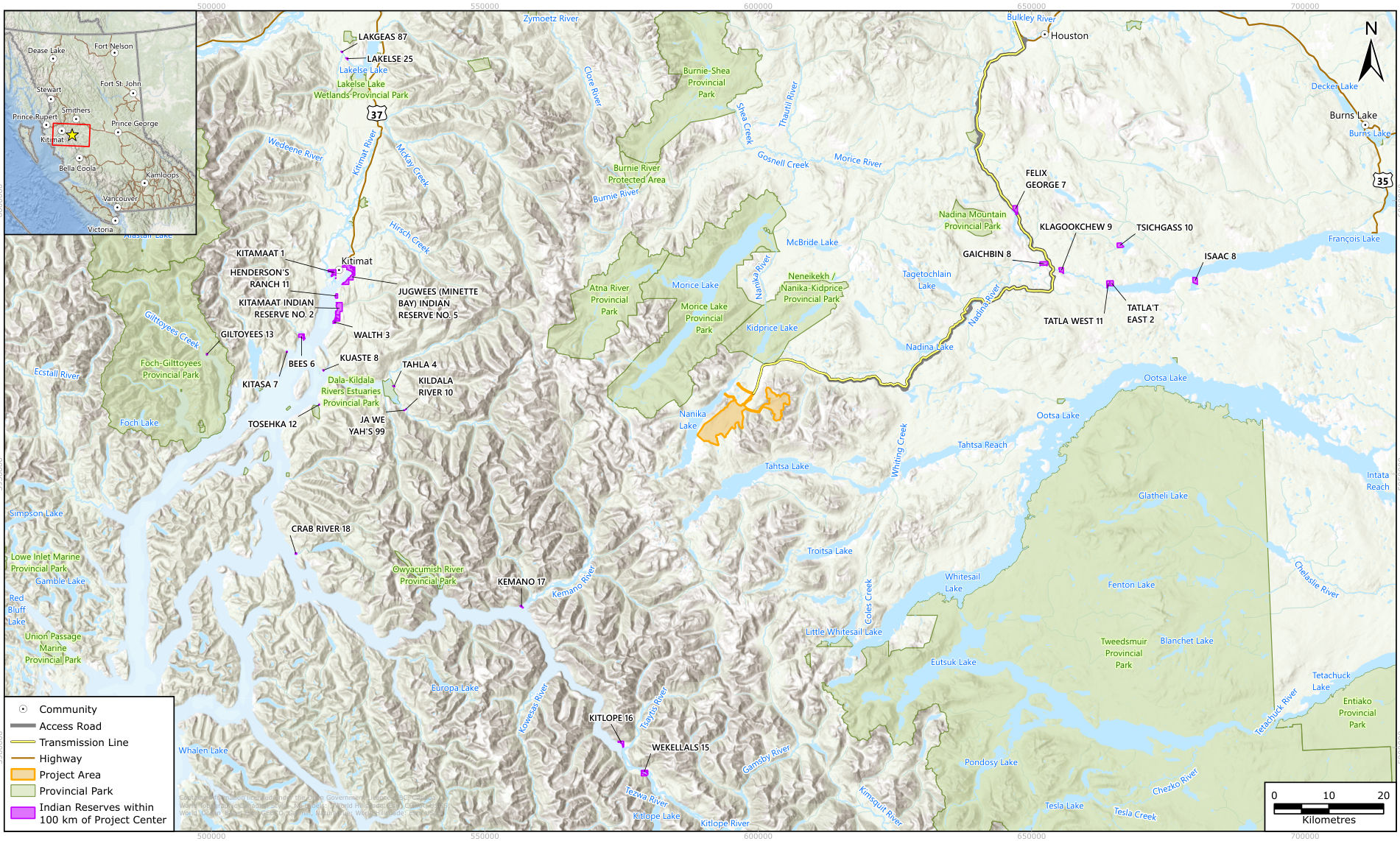
The Nations in the IPD
Office of the Wet'suwet'en (Hereditary Chiefs)
The OW, based in Smithers, is the administrative and representative body for the Hereditary Chiefs of all five clans. The IPD puts the people they represent at about 3,000 to 3,200. Source: IPD, p. 6-8.
Agreements. A Communications and Engagement Agreement was signed in 2013 and amended in May 2024. A Capacity Funding Agreement for the OW-led assessment followed in 2026; the IPD dates it to March in Table 6.2-1 and to April in the text. Surge understands the OW assessment to be a five-stage process "structured to support Hereditary Chiefs and their House members in independent, informed decision-making". Source: IPD, p. 6-3, Table 6.2-1; IPD, p. 6-6; IPD, p. 6-10.
Engagement. Activity rose from about 40 contacts in 2023 to about 150 in 2024. House scoping sessions for Thin House members were held on May 20, 2026 and planned for September 11, 2026, the second on the tailings facility. OW technicians took part in the 2026 wildlife, fisheries and vegetation field programs. Source: IPD, p. 6-11, Table 6.6-1; IPD, p. 4-10; IPD, p. 6-13.
Interests the IPD records (Table 6.6-2, which includes feedback on the draft IPD):
- The principle that "when taking something from the earth one must replace it with something". Source: IPD, p. 6-14.
- Traditional harvest of salmon, berries, game and medicines, typically in August. Source: IPD, p. 6-13; IPD, p. 6-14.
- Yintah Management Directives, which the OW shared with Surge. Source: IPD, p. 6-15.
- Watershed health: "Maintaining the health of the Morice River Watershed is important for the well-being of salmon and Wet'suwet'en members." Source: IPD, p. 6-15.
- Gaps in the baseline: cameras not baited, eDNA gathered at too few sites, no added sampling at Nanika Falls, and OW technicians unable to join all fieldwork. Source: IPD, p. 6-15.
- Employment, training and economic participation for House members, and enough capacity funding for the OW to take part. Source: IPD, p. 6-15.
- A consent-based approach that considers Wet'suwet'en rights and title. Source: IPD, p. 6-16.
The IPD also lists principles of the Wet'suwet'en Natural Resource Project Development Protocol, beginning with "Assurance the development Project will not pose a threat of irreparable environmental impacts". Source: IPD, p. 6-13.
Witset First Nation
Witset, formerly Moricetown, sits on the Bulkley River about 30 km west of Smithers. About 2,100 people are registered members. It is governed by an elected Chief, Deputy Chief and 10 councillors; the Chief is Elgin Cutler, elected in 2025. Source: IPD, p. 6-16.
Engagement began in early 2026. Chief and Council met Surge in May, and members of Council and the president of the Youth Council visited the site in August 2026. A capacity agreement was still being discussed. Source: IPD, p. 6-17.
Interests: fisheries work and participation in field programs, economic development, training, and protection of "fisheries and water resources" in the design criteria for the tailings facility. Source: IPD, p. 6-17, Table 6.7-2.
Notice. On September 29, 2026, Witset replied to the EAO that it "wishes to be a participating Nation". The EAO's message to Witset noted that Witset is already a participating Indigenous nation for the Tenas coal project. Source: Witset First Nation notice, Sep 29, 2026, p. 1.
The IPD gives two different reserve counts for Witset: two reserves of about 666 hectares in Table 6.2-1, and seven reserves of about 1,427 hectares in section 6.7.1. Source: IPD, p. 6-3, Table 6.2-1; IPD, p. 6-16.
Wet'suwet'en First Nation
Wet'suwet'en First Nation, formerly the Broman Lake Indian Band, has about 250 members and 11 reserve parcels totalling about 700 hectares. Most members live at Palling No. 1 on Decker Lake, between Burns Lake and Houston. A Chief and two Councillors are elected for three-year terms. Its economic arm is Yinka Dene Economic Development Limited Partnership. Source: IPD, p. 6-18.
Agreements and engagement. Engagement dates from 2013 and grew from 2021. A Collaboration and Cooperation Agreement was signed in February 2024. Surge and Yinka Dene jointly sought federal funding for a First Nation-led study of power supply options; an application in February 2024 was denied, and a re-submission was conditionally approved in April 2026. Chief Maureen Luggi visited the site in July 2026. Source: IPD, p. 6-18; IPD, p. 6-19, Table 6.8-1; IPD, p. 6-20.
Interests: a consent-based process "that honours the UN Declaration on the Rights of Indigenous Peoples"; long-term mental health of the community's youth; long-term sustainability of traditional land uses; and employment, training and joint-venture contracting. Source: IPD, p. 6-20; IPD, p. 6-21.
Notice. On October 2, 2026, the Nation's referrals coordinator wrote that "Wet'suwet'en First Nation would like to be a participating nation in the impact assessment process." Source: Wet'suwet'en First Nation notice, Oct 2, 2026.
Skin Tyee First Nation
Skin Tyee formed in 2000 when it separated from Nee Tahi Buhn. It has 192 registered members, 45 of them living on reserve, and seven reserves of about 411.9 hectares around Uncha Lake and Southbank. The IPD states that its closest reserve is 66 km from the project; Table 6.2-1 gives about 90 km. Source: IPD, p. 6-23; IPD, p. 6-3, Table 6.2-1.
Engagement. A Protocol Agreement was signed in August 2014, but "Limited engagement has occurred to date". Surge attributes unanswered contacts partly to Skin Tyee's capacity, and writes that the expectation to engage Skin Tyee directly, outside the OW, "was not made clear until recently". Surge presented its PFS to Council in April 2026. Hereditary Chief Ludooks, Chief Samooh and an elected councillor visited the site in July 2026. Source: IPD, p. 6-23; IPD, p. 6-24.
Interests: capacity funding, direct engagement with Skin Tyee, and participation in baseline studies. Source: IPD, p. 6-25, Table 6.9-2.
Notice. On October 15, 2026, counsel for Skin Tyee confirmed it wishes to be a participating Indigenous nation, adding: "Skin Tyee is entitled to and expects direct consultation for the Project." Source: Skin Tyee First Nation notice, Oct 15, 2026.
Nee Tahi Buhn Indian Band
Nee Tahi Buhn is the Wet'suwet'en name for Francois Lake and means "it fills at one end and empties at the other." The band has five reserve areas covering 144 hectares near the south shore of Francois Lake; the closest is about 80 km from the resource area. Source: IPD, p. 6-25; IPD, p. 6-26.
Engagement renewed in early 2026; Surge briefed Chief and Council in April, and they visited the site in the summer of 2026; the text dates the visit to August and Table 6.10-1 to July. Source: IPD, p. 6-26.
Interests: robust fisheries data, and a clear understanding of water use and volume because droughts affect water availability. Source: IPD, p. 6-27, Table 6.10-2.
Cheslatta Carrier Nation
The Cheslatta people lived on Cheslatta and Murray lakes until 1952, when the Kenney Dam flooded the Nechako River and nearby lakes and rivers and forced the Nation from its homelands. Its offices are now in Southbank. It has 383 registered members and 17 reserves of 1,402.8 hectares, and is led by Chief Janet Whitford and two Councillors. Source: IPD, p. 6-27; IPD, p. 6-28.
Engagement dates from 2005. A Letter of Understanding was signed in 2010 and amended in 2013. The IPD states that "Surge has received CCN support for the Project"; that is the company's statement. Source: IPD, p. 6-28; IPD, p. 6-29.
Interests: fish and fish habitat, given the dam's long-term effects; moose and caribou, including caribou recovery; rights and title; Traditional Knowledge; economic participation; and possible help from the First Nations Major Projects Coalition. Source: IPD, p. 6-30; IPD, p. 6-31; IPD, p. 6-32.
The House of Anaskaski
The IPD lists Anaskaski, "Where it Lies Blocking the Trail", among the houses of the Gitdumden (Bear/Wolf) Clan in Table 6.5-1. It does not discuss the House further. Source: IPD, p. 6-8, Table 6.5-1.
On October 14, 2026, Chief Madeek gave notice that the House intends to participate as a Participating Indigenous Governing Body under section 14(1) of BC's Environmental Assessment Act. The House understands that its territory, House Territory Code W06, "overlaps with the proposed transmission-line component of the Project". The letter is copied to the Office of the Wet'suwet'en Hereditary Chiefs. Source: Anaskaski House notice, Oct 14, 2026, p. 1; Anaskaski House notice, Oct 14, 2026, p. 2.
Nothing in this letter or in Anaskaski's participation in any federal or provincial process is consent to the Project, to any Project component, to the proposed transmission line, to any substitution of a federal assessment, or to any infringement of Anaskaski's title or rights.Source: Anaskaski House notice, Oct 14, 2026, p. 1.
Agreements at a glance
| Governing body | Agreement with Surge, as the IPD reports it | Notice on the registry |
|---|---|---|
| Office of the Wet'suwet'en | Communications and Engagement Agreement (2013, amended May 2024); Capacity Funding Agreement (2026) Source: IPD, p. 6-3, Table 6.2-1. | None |
| Witset First Nation | Capacity agreement being pursued Source: IPD, p. 6-3, Table 6.2-1. | Sep 29, 2026 |
| Wet'suwet'en First Nation | Collaboration and Cooperation Agreement with Yinka Dene (Feb 2024) Source: IPD, p. 6-3, Table 6.2-1; IPD, p. 6-19. | Oct 2, 2026 |
| House of Anaskaski | Not discussed in the IPD | Oct 14, 2026 |
| Skin Tyee First Nation | Protocol Agreement (Aug 2014) Source: IPD, p. 6-23. | Oct 15, 2026 |
| Nee Tahi Buhn Indian Band | Draft term sheet provided April 2026 Source: IPD, p. 6-26, Table 6.10-1. | None |
| Cheslatta Carrier Nation | Letter of Understanding (2010, amended 2013) Source: IPD, p. 6-3, Table 6.2-1. | None |
"None" means the registry's seven documents include no notice from that body as of October 20, 2026. The registry does not show whether the EAO received other replies.
Under earlier provincial agreements for the neighbouring Huckleberry Mine, Cheslatta Carrier Nation received 5.2% and Wet'suwet'en First Nation 4.7% of annual incremental mineral tax revenue. Source: IPD, p. 6-6.
What comes next
Early Engagement, scheduled for the fourth quarter of 2026 to the first quarter of 2027, ends with the EAO identifying Participating Indigenous Nations. Surge plans monthly coordination with the OW and quarterly meetings with the Chief and Council of each Band. Source: IPD, p. 5-7, Table 5.6-1; IPD, p. 6-36, Table 6.13-1; IPD, p. 6-37.
Our assessment. We assess that the tables of interests in chapter 6 are Surge's account of what it has heard, and each Nation's own submissions will test them. The notices already show emphases the IPD gives less weight: Skin Tyee's insistence on direct consultation, and Anaskaski's explicit reservation of consent and its focus on the transmission line. See the review timeline for the steps ahead.
Sources
- Surge Copper, Initial Project Description and Engagement Plan, September 2026: chapter 6 and sections 1 and 3.2
- Witset First Nation, notice of intent to participate, Sep 29, 2026
- Wet'suwet'en First Nation, notice of intent to participate, Oct 2, 2026
- House of Anaskaski, notice of participation, Oct 14, 2026
- Skin Tyee First Nation, notice of intent to participate, Oct 15, 2026
Page references give the printed page label; each link opens the PDF at that page.