What Surge Copper says
This page is a copy of what Surge Copper Corp. tells investors about Berg Copper Project on its own website. It reproduces Surge Copper's maps and tables for public information, and it sets out those figures in Surge Copper's own terms. Every statement here is Surge Copper's, from its project page as read on October 22, 2026, unless it is marked otherwise.
How this page fits the record
Surge Copper's website is promotional disclosure for investors. It is not part of the environmental assessment (EA) record, and no regulator has reviewed it. Its figures come from Surge Copper's June 2026 Pre-Feasibility Study (PFS), which it prepared under National Instrument 43-101, the Canadian standard for disclosure about mineral projects. Other pages of this site draw on the Initial Project Description (IPD) that Surge Copper filed with the Environmental Assessment Office in September 2026. The IPD is the document of record; this page shows how Surge Copper presents one project to investors. Source: Surge Copper website; IPD, p. 4-26.
Net present value, rate of return and payback figures appear only on its website and in the PFS. They depend on assumed metal prices, and Surge Copper states that its mineral resources "do not have demonstrated economic viability". Source: Surge Copper website, Technical disclosure.
Surge Copper's summary
Surge Copper describes Berg as its "100%-owned flagship copper-molybdenum-silver project", located in central British Columbia within the Wet'suwet'en Yintah. It proposes a stand-alone open pit and concentrator, reached by existing regional roads and powered from BC Hydro's grid. It calls Berg "one of Canada's most significant emerging critical minerals development projects". Source: Surge Copper website, Overview.
Where it is and how it connects
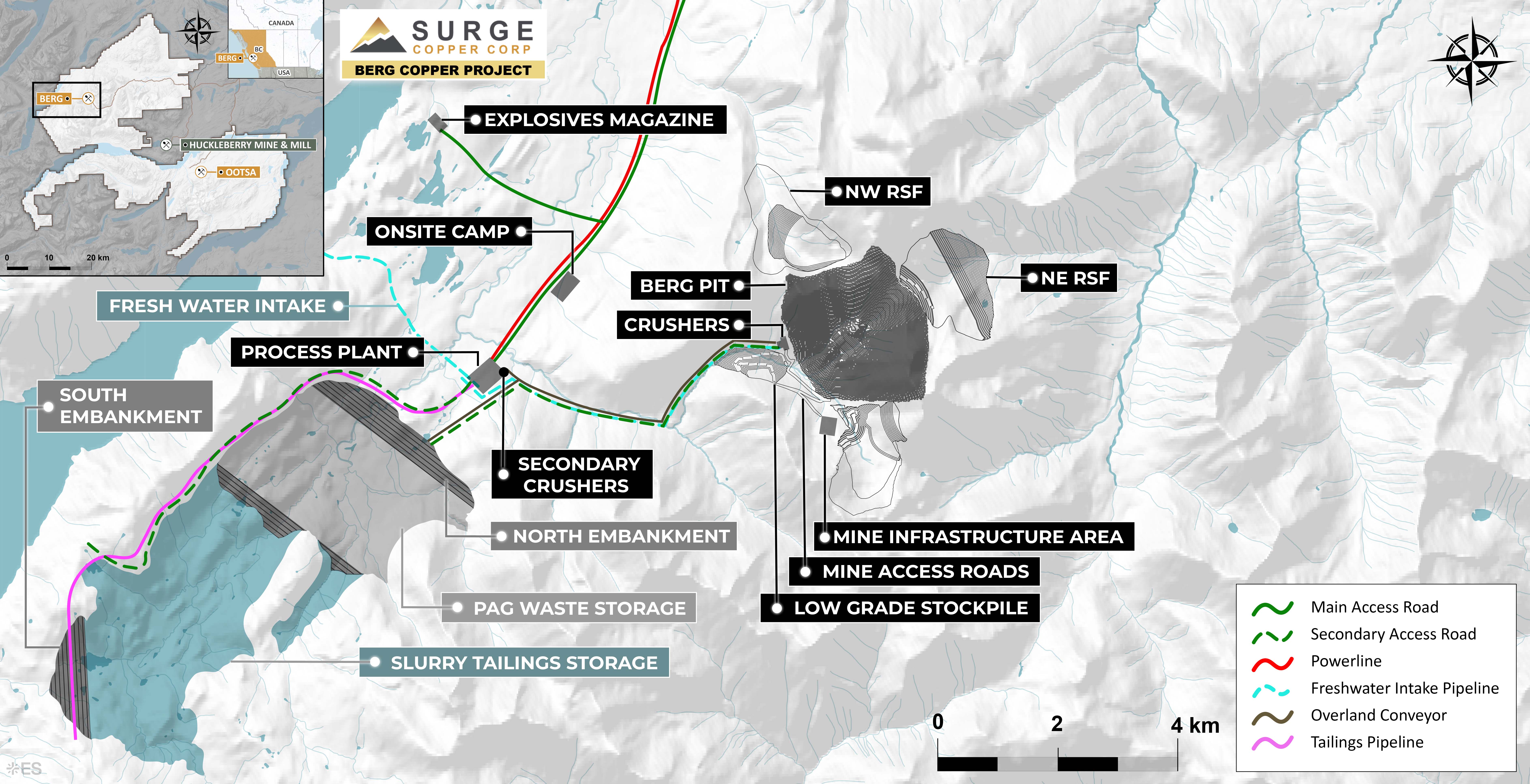
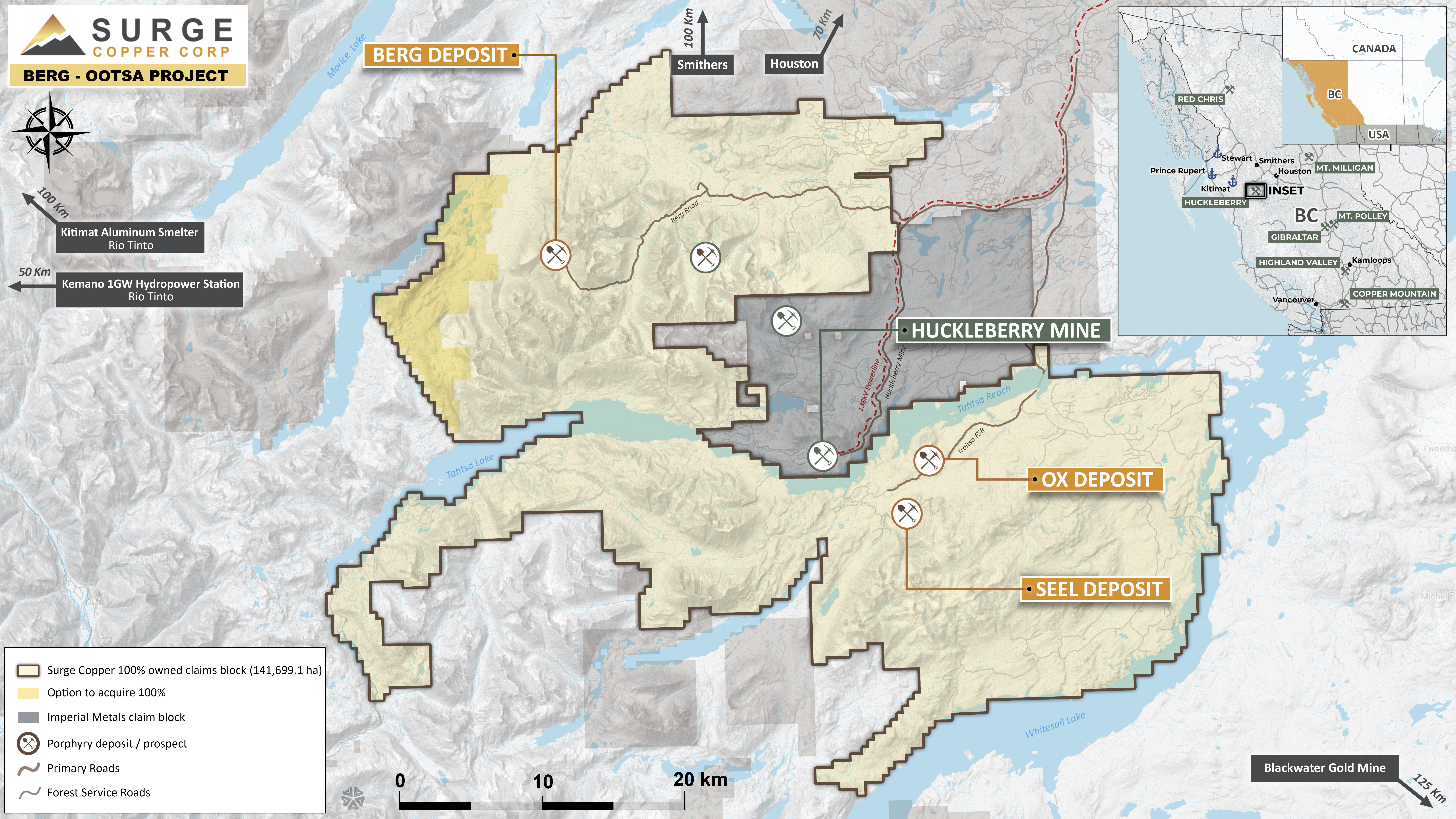
Surge Copper plans to reach its site over existing forest service roads from Houston. A new 230 kilovolt (kV) transmission line follows the access road's general corridor and connects to BC Hydro's grid at Telkwa substation. Ore travels downhill from pit to process plant by electric overland conveyor, which Surge Copper says lowers energy use and carbon intensity compared with diesel haulage. Source: Surge Copper website, Infrastructure and power.
Deposit, reserve and resource
Surge Copper describes Berg as a calc-alkaline copper and molybdenum porphyry system. The ore forms a broad ring around a body of intrusive rock called Berg Stock. It includes primary ("hypogene") ore and a blanket of ore enriched near surface ("supergene"). Source: Surge Copper website, Mineral reserve and resource.
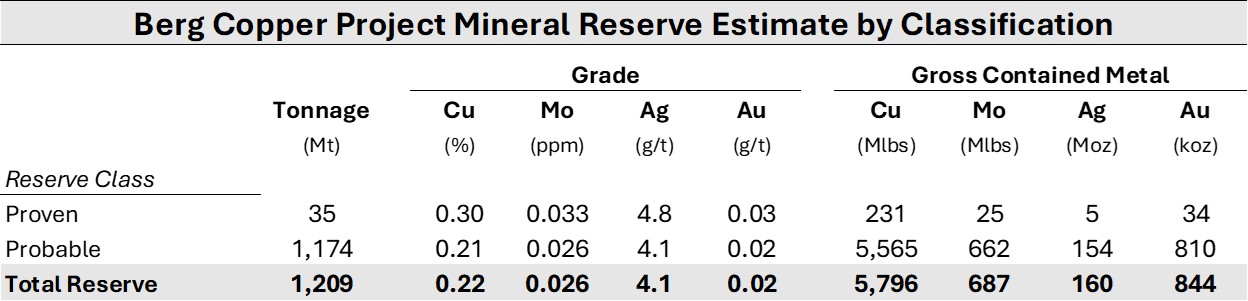
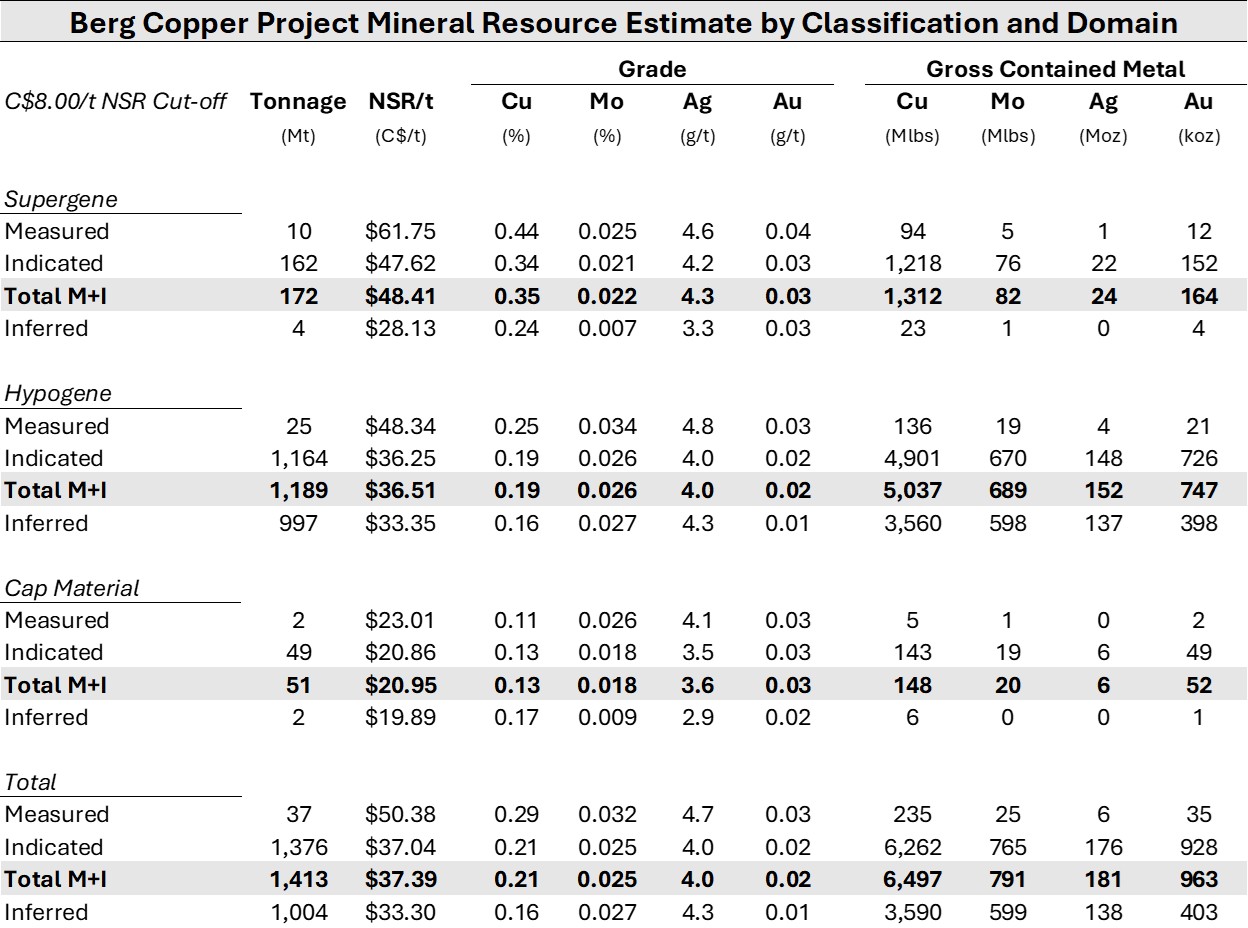
A mineral reserve is that part of a resource which a study shows can be mined at a profit. The PFS declares Berg's first reserve: 1,209 million tonnes (Mt) grading 0.22% copper. Most of this reserve (1,174 Mt) is in the less certain "probable" class. Its resource is larger, and includes about 1.0 billion tonnes of "inferred" material, least certain of all classes, which its mine plan does not count as ore. Source: Surge Copper website, Mineral reserve and resource.
| Class | Mt | Cu % | Mo ppm | Ag g/t | Au g/t | Cu Mlb | Mo Mlb | Ag Moz | Au koz |
|---|---|---|---|---|---|---|---|---|---|
| Proven | 35 | 0.30 | 0.033 | 4.8 | 0.03 | 231 | 25 | 5 | 34 |
| Probable | 1,174 | 0.21 | 0.026 | 4.1 | 0.02 | 5,565 | 662 | 154 | 810 |
| Total | 1,209 | 0.22 | 0.026 | 4.1 | 0.02 | 5,796 | 687 | 160 | 844 |
Transcribed from Surge Copper's table (original image). The molybdenum grade column is headed "ppm" in its original, but its values match percent; Surge Copper's text gives 0.026% molybdenum. This reserve is reported at a net smelter return (NSR) cut-off of C$9.25 a tonne, estimated by Marc Schulte, P.Eng., of Moose Mountain Technical Services. Source: Surge Copper website, Notes to the Mineral Reserve.
| Class | Mt | NSR C$/t | Cu % | Mo % | Ag g/t | Au g/t | Cu Mlb | Mo Mlb | Ag Moz | Au koz |
|---|---|---|---|---|---|---|---|---|---|---|
| Measured | 37 | 50.38 | 0.29 | 0.032 | 4.7 | 0.03 | 235 | 25 | 6 | 35 |
| Indicated | 1,376 | 37.04 | 0.21 | 0.025 | 4.0 | 0.02 | 6,262 | 765 | 176 | 928 |
| Measured and Indicated | 1,413 | 37.39 | 0.21 | 0.025 | 4.0 | 0.02 | 6,497 | 791 | 181 | 963 |
| Inferred | 1,004 | 33.30 | 0.16 | 0.027 | 4.3 | 0.01 | 3,590 | 599 | 138 | 403 |
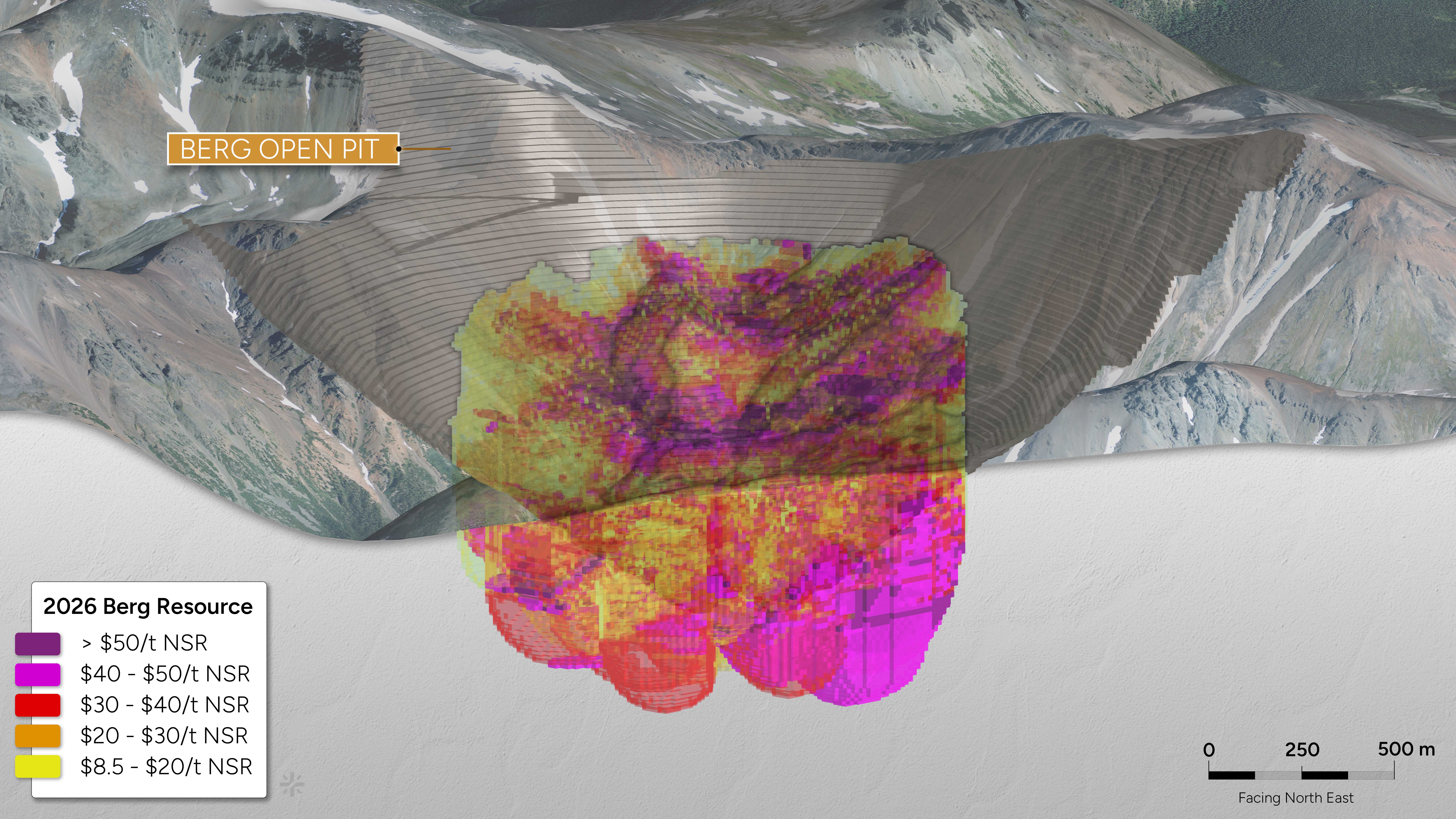
Transcribed from Surge Copper's table, which also breaks its resource into supergene, hypogene and cap domains (original image). Estimated by Sue Bird, P.Eng., of Moose Mountain Technical Services, at US$4.50/lb copper, US$20/lb molybdenum, US$40/oz silver and US$3,000/oz gold. Source: Surge Copper website, Notes to the Mineral Resource Estimate.
Mining, milling and production
Surge Copper plans conventional open-pit mining at a life-of-mine strip ratio of 2.0 tonnes of waste for each tonne of ore, including rock removed before production. Its mill grinds ore and separates copper and molybdenum concentrates by flotation. It expects average recoveries of 84% for copper, 88% for molybdenum, 55% for silver and 52% for gold. Source: Surge Copper website, PFS mine plan; Surge Copper website, Metallurgy and processing.
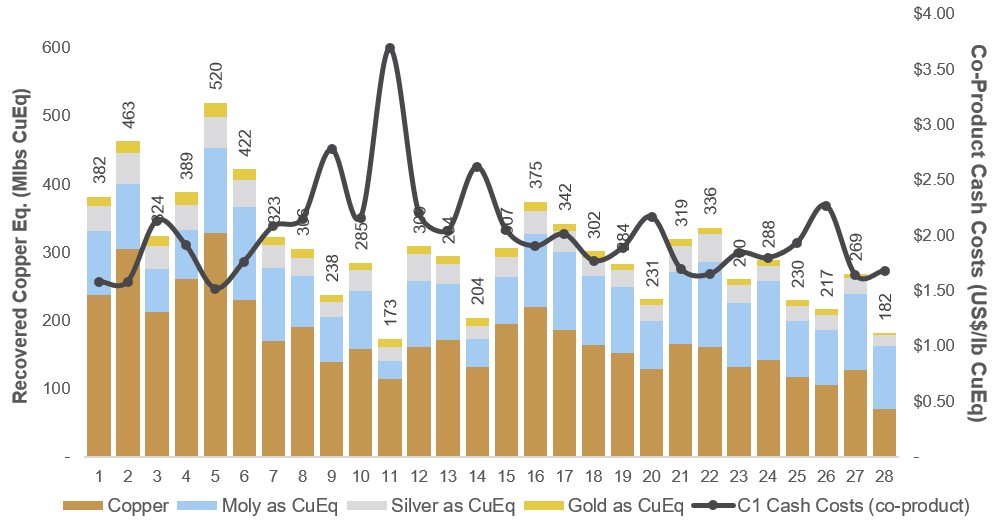
Production is heaviest early. First five years of steady production average 416 million pounds of copper equivalent a year, against 308 million pounds a year over its whole mine life. Copper alone averages 176 million pounds a year. Source: Surge Copper website, PFS mine plan.
Economic estimates
Surge Copper's base case assumes US$4.75/lb copper, US$20.00/lb molybdenum, US$45/oz silver and US$3,500/oz gold, at 0.73 US dollars to the Canadian dollar. On those prices it estimates an after-tax net present value of C$4.6 billion at an 8% discount rate, an after-tax internal rate of return of 24% and a payback of 2.9 years. It estimates C$16.9 billion of free cash flow and C$8.3 billion of taxes over mine life. At June 2026 spot prices, its net present value estimate rises to C$9.4 billion. Source: Surge Copper website, Economic summary.
Tailings, water and closure
Surge Copper plans one tailings and waste management facility. Water from it is recycled to the mill during operations, which it says reduces water demand and discharge. At closure it expects to remove its plant, re-contour pit and waste rock areas as required, treat and monitor water where necessary, and cap and revegetate tailings. It intends to work with First Nations on reclamation planning. The tailings page sets out the design as filed in the IPD. Source: Surge Copper website, Tailings, waste and water management.
First Nations and assessment
Surge Copper states that it is engaging with the Wet'suwet'en Hereditary Chiefs and Houses, Witset First Nation, Wet'suwet'en First Nation, Nee Tahi Buhn Indian Band, Skin Tyee First Nation and Cheslatta Carrier Nation. It describes its approach as grounded in "the pursuit of free, prior, and informed consent". It plans for the Office of the Wet'suwet'en to carry out an Indigenous-led assessment alongside provincial and federal assessments, and it seeks a single assessment led by BC on behalf of both governments. The First Nations page and the review page set out what Nations and BC have filed. Source: Surge Copper website, First Nations and project advancement; Surge Copper website, Environmental assessment and permitting.
It also states that BC's Critical Minerals Office has accepted Berg, and that inferred resources within and below the reserve pit offer room to grow beyond its current plan. Source: Surge Copper website, Environmental assessment and permitting; Surge Copper website, Future opportunities.
About this copy
The text and figures on this page are © Surge Copper Corp. They are reproduced for public information and comment. The archived text preserves Surge Copper's page as read on October 22, 2026, and full-size originals of its maps are linked from each figure. Surge Copper's own page is at surgecopper.com/projects/berg-project, and its PFS technical report is listed at surgecopper.com/projects/berg-project/pfs.