Tailings and mine waste
Berg would store its tailings and its acid-generating waste rock together, under water, in one facility beside Nanika Lake. This page describes that facility, how its site was chosen, how the rock is classified, and what the company says remains to be studied.
The short version
- Berg would keep its tailings and its acid-making waste rock together in one large pond. The company calls the site beside Nanika Lake "currently preferred". Source: IPD, p. 4-11; IPD, p. 4-3, Figure 4.1-1.
- The pond is designed for 1,263 million tonnes of tailings and 1,304 million tonnes of rock that can make acid. Source: IPD, p. 4-12.
- The rock is kept under at least 3 metres of water, because air and water together make it release acid. Source: IPD, p. 4-12.
- Two dams hold the pond. They are raised in stages as the mine grows. Source: IPD, p. 4-11; IPD, p. 4-22.
- The water has to stay over the rock for good. If it drops through drought, a dam breach or pumping, the rock can begin to make acid. Source: IPD, p. 10-3.
- The site is not final. Other sites are being compared with First Nations, and the company acknowledges concern about "the proximity of the facility to critical downstream habitat". Source: IPD, p. 4-10; IPD, p. 4-11.
- Studies of seepage, water quality and closure are still to come. Source: IPD, p. 4-12.
For the full account, with every figure and source, choose Informed.
Terms and notation
| AP, NP | Acid potential and neutralization potential of a rock sample. |
| NPR | Neutralization potential ratio, NP / AP. |
| PAG, NPAG | Potentially acid-generating and non-acid-generating rock. |
| ARD | Acid rock drainage. |
| TWMF | Tailings and Waste Management Facility. |
| IDF, PMF | Inflow design flood; probable maximum flood. |
| PGA | Peak ground acceleration, in units of g. |
| GISTM | Global Industry Standard on Tailings Management. |
| MDMER | Metal and Diamond Mining Effluent Regulations (federal). |
In brief
The Tailings and Waste Management Facility (TWMF) is designed to hold 1,263 million tonnes of tailings and 1,304 million tonnes of potentially acid-generating (PAG) waste rock, with at least 3 metres of water over the rock in the long term to prevent acid generation. Two embankments contain it, and they are raised in stages over the mine life. The company calls this location "currently preferred". A multiple accounts analysis of alternatives is under way with First Nations, and the IPD acknowledges concerns about "the proximity of the facility to critical downstream habitat". Studies of seepage, water quality and closure are still to come.
What the facility holds
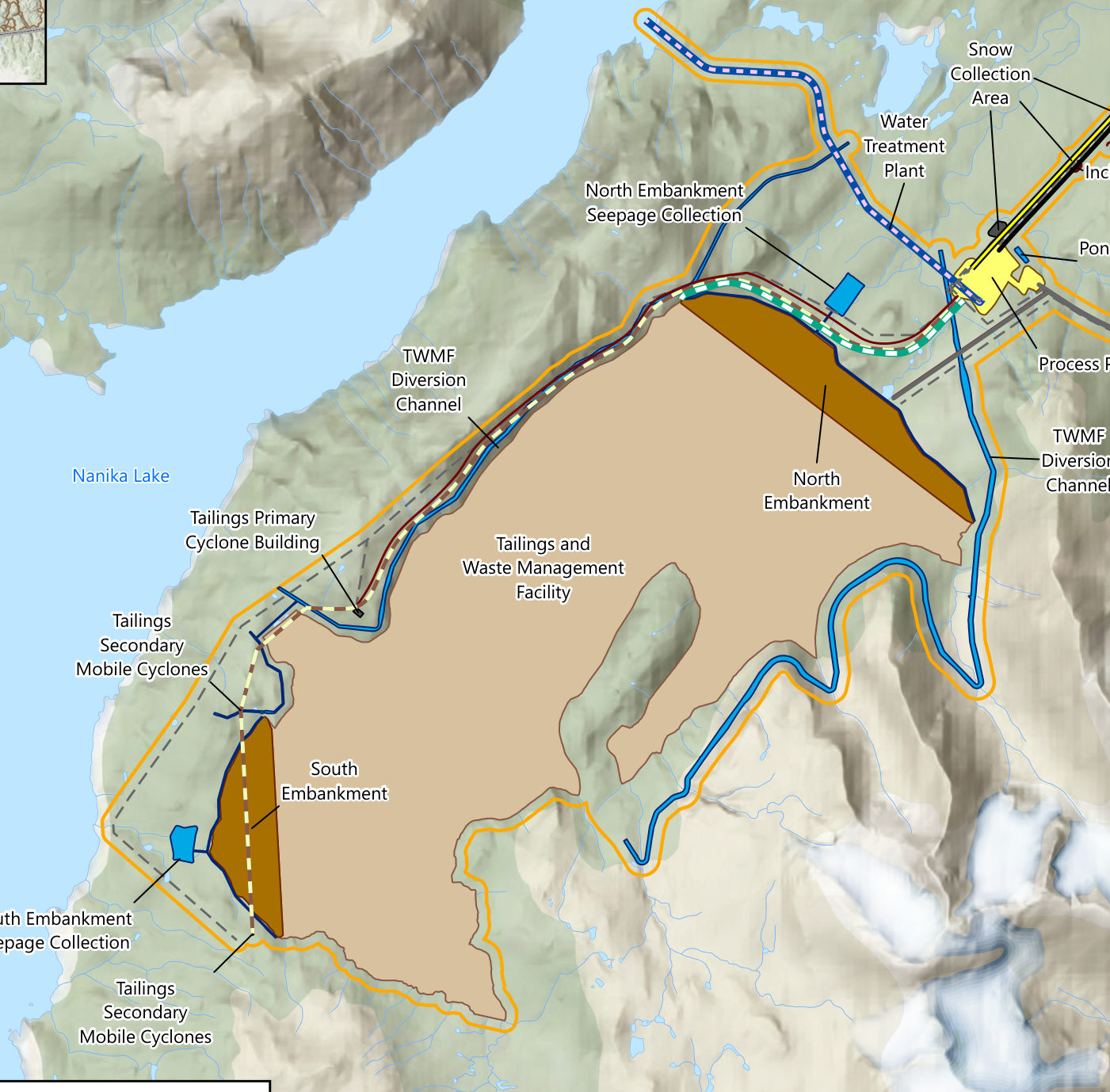
The TWMF is a "co-disposal" facility: it receives slurry tailings from the mill and PAG waste rock from the pit. Acid-generating rock is crushed at the pit and carried by conveyor, in an estimated five segments joined by four transfer stations. It is placed at the northeast end of the facility against the northeast embankment. Tailings are piped from the plant in a large-diameter plastic (acrylonitrile butadiene styrene) line and discharged from the southwest end, where they form beaches toward the centre and against the rock. Source: IPD, p. 4-8; IPD, p. 4-11; IPD, p. 4-12.
The company states the facility's primary design objectives as the secure containment of tailings, the "subaqueous deposition of PAG waste rock to prevent potential ARD", and protection of groundwater and surface water during operations and after closure. Water from the facility is recycled to the mill for flotation. Source: IPD, p. 4-12.
The embankments
- Northeast embankment. Built entirely of non-acid-generating (NPAG) waste rock. In the early years some of this rock is crushed and conveyed to the facility for dam building. Source: IPD, p. 4-11; IPD, p. 4-8.
- Southwest embankment. Built of sand from overburden and from the coarse fraction of the tailings, both assumed to be non-acid-generating. The company assumes sand can be placed only seven months of the year because of the cold; in the five cold months whole tailings go into the facility as slurry. Source: IPD, p. 4-11.
- Staged raises. The facility is enlarged "as required throughout the mine life with subsequent dam raises". Source: IPD, p. 4-22.
The text names the embankments "northeast" and "southwest"; Figure 4.1-1 labels them "North Embankment" and "South Embankment". Source: IPD, p. 4-11; IPD, p. 4-3, Figure 4.1-1.
Design standards
The design uses a conceptual dam hazard classification. The company states that, "Conservatively", the inflow design flood for operations and post-closure would be the probable maximum flood for a "very high" dam classification, and that the spillway would be designed to pass it. Earthquake design uses an assumed peak ground acceleration of 0.126 g. Piezometers, slope inclinometers and survey monuments are to monitor the embankments. Source: IPD, p. 4-12.
Surge commits to the Global Industry Standard on Tailings Management and cites the Mining Association of Canada tailings guide, federal guidelines on alternatives for mine waste disposal, BC's mining code and its tailings dam guidance, and the Canadian Dam Association's 2013 guidelines. Source: IPD, p. 4-10; IPD, p. 4-18.
How the site was chosen
The location came out of trade-off studies in the 2023 Preliminary Economic Assessment. The company lists the factors weighed: environmental footprint, volume and capacity, dam geometry and fill, proximity to the mine with a focus on reducing footprint, natural topography and containment, water management, "Limiting watershed disturbances to a single catchment", and suitability for storing waste rock in the same place. Source: IPD, p. 4-8; IPD, p. 4-10.
The choice is not final. A multiple accounts analysis is under way "in discussion with First Nations", and a Best Available Technology report on alternatives is to go to regulators early in the review. The IPD rates tailings management as "Flexible" in its table of design constraints. Source: IPD, p. 4-10; IPD, p. 4-19, Table 4.2-1.
Surge recognizes that concerns have been raised regarding the proximity of the facility to critical downstream habitat, and will continue to work with OW technical staff, and other communities on the criteria, considerations and alternatives for TWMF.Source: IPD, p. 4-11. OW is the Office of the Wet'suwet'en.
One part of the plan is closed to alternatives. For storing acid-generating rock inside the TWMF, Table 4.7-1 states: "Due to ongoing risks and concerns for PAG waste rock storage, no additional alternatives are being considered." Source: IPD, p. 4-38, Table 4.7-1.
What others have said about it
- Office of the Wet'suwet'en. A House scoping session for Thin House members on the TWMF and its alternatives was planned for September 11, 2026. A June 2026 meeting covered the TWMF dam height, geotechnical and site stability studies, and the long-term health of the Nanika watershed. Source: IPD, p. 4-10; IPD, p. 6-12.
- Witset First Nation. Witset "indicated that protection of fisheries and water resources was an important consideration within the design criteria for the TWMF". Source: IPD, p. 6-17, Table 6.7-2.
- Cheslatta Carrier Nation. Engagement in July 2026 covered preliminary design considerations and siting criteria for the tailings alternatives assessment. Source: IPD, p. 6-30.
- Local governments. They raised the design, footprint and construction of the TWMF, including land disturbance and effects on topography and drainage. Source: IPD, p. 7-8, Table 7.1-4.
Fish-bearing water
The IPD lists an amendment to Schedule 2 of the federal Metal and Diamond Mining Effluent Regulations (MDMER) among anticipated federal approvals. That listing is required to use natural waterbodies frequented by fish as tailings impoundment areas or for other mine waste. Table 10-1 says the amendment "may be required if waterbody supporting fish habitat must be used as a tailings impoundment". Source: IPD, p. 5-6, Table 5.4-2; IPD, p. 10-10.
Our assessment. We assess that the IPD leaves open whether the TWMF footprint covers fish-bearing water. It does report Dolly Varden throughout accessible reaches of the Bergeland Creek watershed, and Figure 4.1-1 shows diversion channels around the facility. The answer will decide whether a Schedule 2 listing and its federal alternatives assessment are needed. Source: IPD, p. 8-8; IPD, p. 4-3, Figure 4.1-1.
Acid-generating rock
Waste rock is classed as either PAG or NPAG. The company anticipates 1,355 million tonnes of PAG and 1,053 million tonnes of NPAG over the mine life, while noting that further geochemistry studies are under way. Source: IPD, p. 4-4; IPD, p. 4-35.
- 2007. The first acid rock drainage study, by AMEC, tested 45 drill core samples and ten water samples. Drilling then was concentrated in the ore zone, so the study "primarily characterized ore". About 87% of samples had neutralization potential ratios below one, which identifies rock as PAG. It also found naturally acidic, metal-rich drainage above the monthly mean concentrations of the federal effluent regulations for some parameters. Source: IPD, p. 8-14; IPD, p. 4-13; IPD, p. 8-3, Table 8-1.
- 2024 to 2026. Surge added 21 samples in 2024, 38 drill samples and 5 surface samples in 2025, and more targeted drilling, field bins and laboratory tests in 2026. A 2026 gap assessment by Lorax Environmental identified further work. Source: IPD, p. 8-3, Table 8-1; IPD, p. 8-14.
- The boundary. Results from 47 samples support a dividing line: rock within a 50-metre altered zone is classed as PAG, and rock outside it to the pit wall as NPAG. Total sulphur is the main predictor of acid risk, and NPAG rock becomes more common with distance from the ore body. Source: IPD, p. 4-13.
- Metal leaching at neutral pH. Tests of metal leaching under dry and submerged conditions are to be completed during the assessment. Source: IPD, p. 4-16.
Classification: NPR = NP / AP, and a sample with NPR < 1 is classed PAG. Source: IPD, p. 4-13.
Design criteria: IDF = PMF for a "very high" dam classification; PGA = 0.126 g; long-term water cover over PAG rock hw ≥ 3 m. Source: IPD, p. 4-12.
Our assessment. Table 10-1 describes waste rock as "preliminary characterized as ~86.7% PAG based on AMEC 2007 testwork". We assess that this restates a share of 2007 samples, taken mostly from ore, as a share of waste rock. The tonnage estimate in section 4.1.1 is 1,355 of 2,408 million tonnes, or about 56% PAG by our arithmetic. Source: IPD, p. 10-4; IPD, p. 8-14; IPD, p. 4-4.
Numbers that do not yet reconcile
- Acid-generating rock. The pit is expected to produce 1,355 million tonnes of PAG rock; the TWMF is designed for 1,304 million tonnes. Source: IPD, p. 4-4; IPD, p. 4-12.
- Tailings. The TWMF is designed for 1,263 million tonnes of tailings, while 1,209 million tonnes of ore are milled. Tailings are what remains of ore after concentrate is removed, so we would expect the smaller number. The IPD does not explain the difference. Source: IPD, p. 4-12; IPD, p. 4-35.
At closure
The company's stated closure objective is for effluent "to meet applicable water quality objectives without ongoing treatment for ARD". Its conceptual plan revegetates the embankments and caps the tailings beach with soil. Water treatment continues until water in the facility meets discharge criteria. After that, treatment stops, diversions are removed, and the TWMF discharges passively through a closure spillway. Source: IPD, p. 4-22; IPD, p. 4-23.
Table 10-1 names the risk this plan has to manage: subaqueous storage "requires a stable, permanent water cover; loss of water cover (drought, dam breach, or operational drawdown) risks re-exposure and onset of ARD". "Failure or breach of water management and containment structures" is among the accident scenarios the application may assess. Source: IPD, p. 10-3; IPD, p. 4-39.
Studies to come
The IPD states that "Future studies now underway will provide further design details, including water and seepage management, water quality predictions, and closure requirements" for the TWMF. Groundwater investigations focused on the TWMF footprint are planned for 2026; three piezometers were installed there in 2025. Source: IPD, p. 4-12; IPD, p. 8-16; IPD, p. 8-15.
Our assessment. We assess that the questions most likely to dominate the review are the water cover's reliability over centuries, seepage toward Nanika Lake and Bergeland Creek, and the outcome of the alternatives analysis. The IPD gives design intent for each but no predictions yet. Telkwa's sibling site describes how a comparable debate over water-covered waste rock unfolded in the Tenas mine review.
Sources
- Surge Copper, Initial Project Description and Engagement Plan, September 2026: sections 4.1.3, 4.1.4, 4.3.3, 4.7, 5.4, 8.1.4 and Table 10-1
Page references give the printed page label; each link opens the PDF at that page.